
Inside the West Health Accelerator at Mass General Brigham: Spotlight on Human-Centered Design
Human-centered design is an approach to problem-solving that puts real people at the center of the design process. In business, it can generate profitable products and services. When applied to healthcare, it drives practical interventions that improve patients’ safety, experience and clinical outcomes.
The West Health Accelerator at Mass General Brigham is putting the principles of human-centered design to work by collaborating with Springboard Studio, a team within Mass General Brigham with deep expertise in human-centered design. The Springboard team ensures the Accelerator’s ideas are shaped in true partnership with frontline providers and patients — leading to solutions that are both meaningful and user-friendly. As the Springboard team explains, “the best solutions come from the people closest to the challenge.”
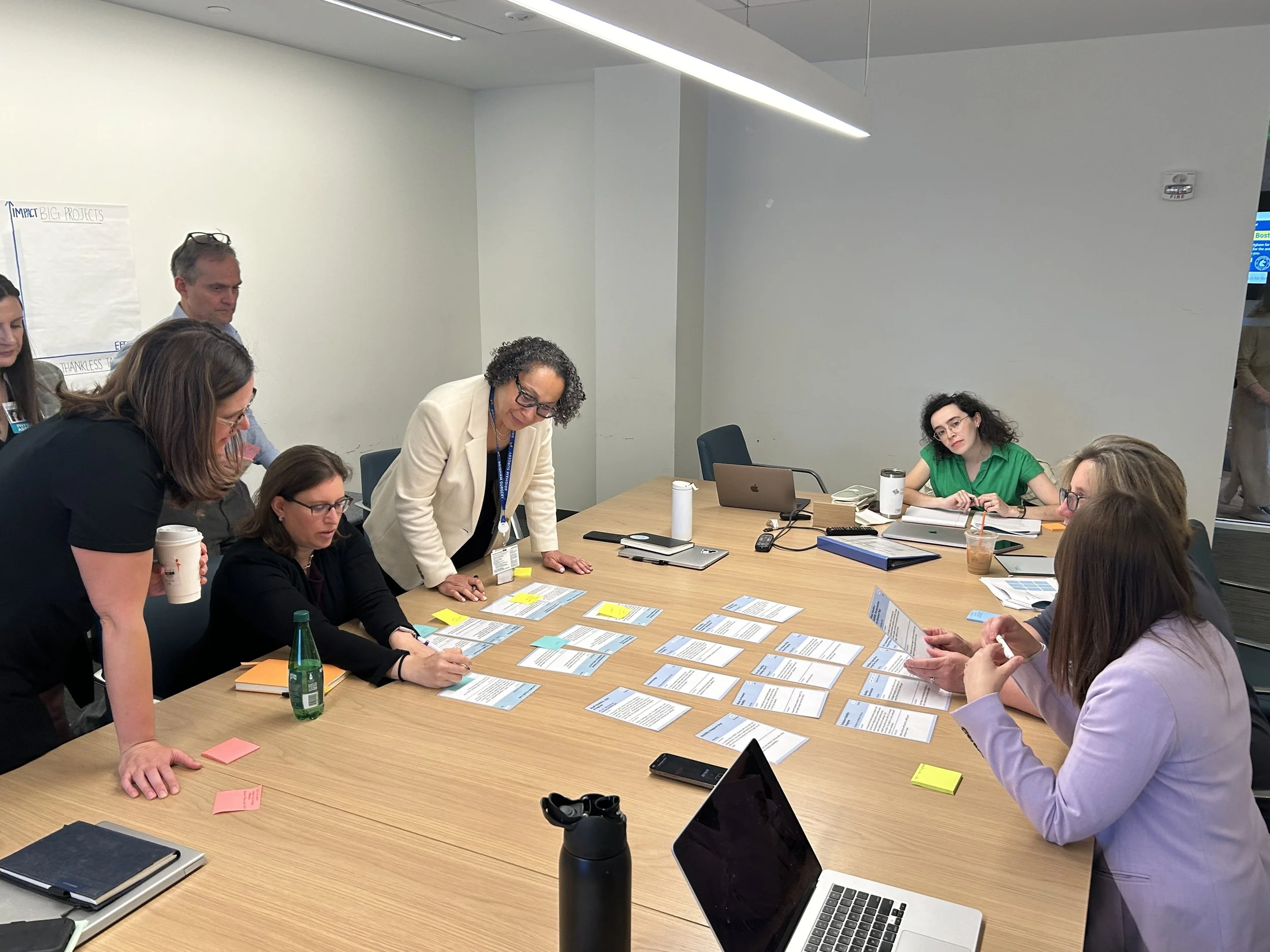
Image provided by Springboard Studio
Putting Human-Centered Design into Practice
In their work on the Accelerator, Springboard’s process follows human-centered design best practices — researching, prototyping, supporting implementation and measuring impact. Since the launch of the Accelerator in November 2024, Springboard has been hosting a series of interviews and ideation sessions, where frontline providers and team members have an opportunity to share existing bright spots in the system, discuss opportunities for innovation and anticipate potential challenges before implementation.
During the collaborative ideation sessions, the Springboard team actively listens and asks clarifying questions. They then gather feedback between meetings to continue refining ideas. To date, this process has yielded valuable insights and direction for the Accelerator, including a list of possible interventions for the West Health Champions to implement as quality improvement projects at their respective sites.
Co-Creating Solutions with Patients and Providers
At a recent ideation session, the team focused on how to ensure older patients feel truly heard and understood in their interactions with care teams. Guided by Springboard, Accelerator team members brainstormed ways to engage patients to better understand what matters to them. The group also reviewed existing mobility initiatives and delirium interventions across the Mass General Brigham system, working toward a shared understanding of which approaches should be prioritized and scaled through the Accelerator.
Through its continued partnership, the Accelerator consistently delivers user-friendly interventions that meet the real needs of older patients and their families — not only in theory, but in practice.
Follow our journey at westhealthacceleratoratmgb.org