
Meet the West Health Accelerator Team: Sevdenur Cizginer, MD, MPH, AGSF
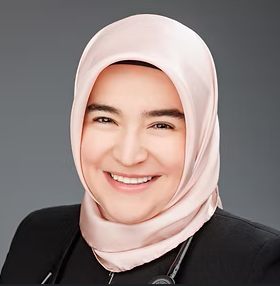
Dr. Sevdenur Cizginer, a physician scientist at Harvard Medical School and a national leader in geriatric surgery, serves as the director of implementation science research for the West Health Accelerator at Mass General Brigham.
In this role, she leads a dedicated team of scientists, research and clinical leaders, and research assistants from the Center for Optimal Aging and Serious Illness at Mass General Hospital. Together, they are working to ensure the Accelerator becomes a success at each of Mass General Brigham’s nine hospitals, with the ultimate goal of creating a scalable model that can be adopted by healthcare systems across the United States.
Q&A
How did you become so passionate about caring for older adults?
Sevdenur Cizginer: My passion for geriatrics has been forged over more than 20 years of caring for sick and frail older patients. Holding a patient's hand and seeing them smile means the world to me. As a geriatrician, I have the unique tools and knowledge to help them, and I am driven to improve their care through clinical practice, research and leadership.
Older adults are the keepers of wisdom — they are the moms, dads, grandparents, friends and loved ones who have spent a lifetime giving to others — and they deserve our utmost support in their time of need. Creating a healthcare system that is more responsive to older patients through proactive, multidisciplinary and individualized care is what fuels my enthusiasm every single day.
What shaped your philosophy on caring for older adults?
SC: My philosophy was shaped early on, not in a hospital, but in my father's art studio. As a child, my primary joy was sitting beside him, a dedicated and successful artist, and contributing to his canvas. Those precious moments taught me the profound importance of details and how a single, critical brushstroke could transform the entire meaning of a painting.
I found a professional parallel in this lesson during my combined medicine-surgery fellowship at Harvard Medical School. I observed that older adults often suffered disproportionately from complications and mortality despite expert care and advanced technology. Later, through my work with the Aging Brain Center at Harvard, I realized that a critical, proactive intervention — much like a decisive brushstroke — could dramatically improve these outcomes. The majority of complications were preventable through seemingly small, but strategically vital actions.
What is implementation science?
SC: A proven patient intervention is only as good as its implementation — you need a strategic, scientific approach to deliver it. Implementation science provides a rigorous toolkit to ensure our brilliant medical breakthroughs don’t just exist in publications, but become lasting, scalable and life-changing care for every patient.
We use frameworks from implementation science to uncover the unique barriers in each setting and create strategies, since what works in one hospital may fail in another. We strategically adapt the intervention for different settings, meticulously identifying, documenting and reporting what adaptations are made and why. We also evaluate if the intervention reaches the target population successfully and is sustained with fidelity over time. This process allows us to tailor the intervention for real-world use without compromising its core ingredients and creates a knowledge base that others can learn from instead of starting from scratch.
How is implementation science being used in the West Health Accelerator?
SC: Within the West Health Accelerator, implementation science is the engine that ensures our new care models are not only effective, but also reach every patient, adapt to different settings and stand the test of time.
This approach allows us to evaluate both the overall Accelerator initiative and its areas of focus. The ultimate goal is to extract the best practices and key lessons on how to successfully run and spread this change. By doing this, we are creating a proven, scalable model that can be eventually replicated effectively in health systems across the country, turning our local success into a new national standard.
What is most exciting to you about the West Health Accelerator?
SC: What excites me most is the unprecedented potential for transformational change at a systems level. With the population of adults over age 85 expected to triple from 6 million to 18 million by 2050, there is an urgent and growing need to fundamentally redesign our healthcare system. We must create one that is not only friendly, but is also safe, and that delivers the excellent, compassionate care every older adult deserves.
This is precisely what we are achieving through our work with the Accelerator. We are driving a fast-paced, large-scale implementation project across our nine hospitals.
Knowing that our work has the potential to set a new national standard — and understanding the sheer number of institutions that could eventually benefit from it — is incredibly powerful. This is the culmination of my life's work, and it is truly exhilarating to see it come to fruition.